What is an IQ test?
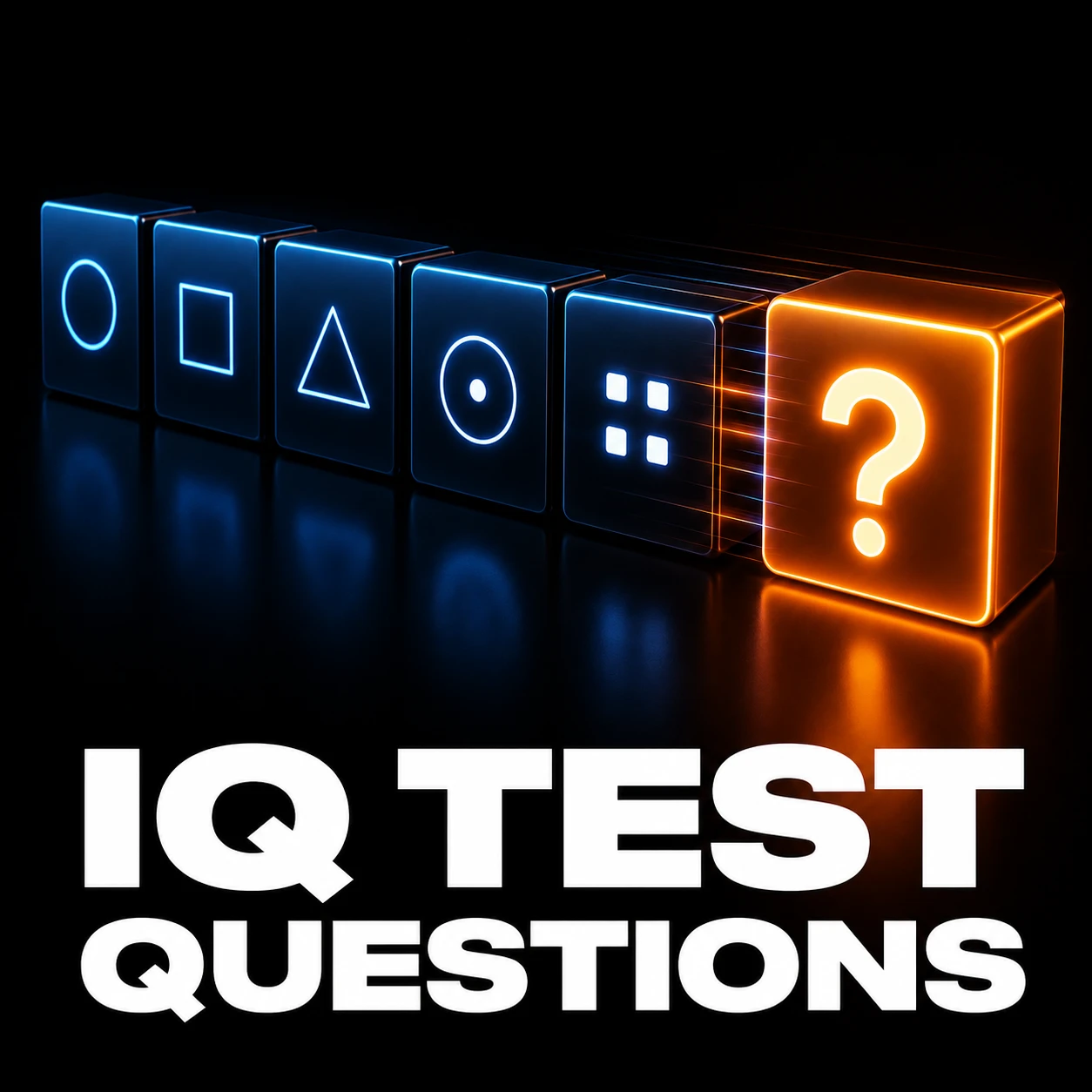
At its core, a set of problems built to sample how you reason: pattern-spotting, relationships between ideas, puzzles you have not met before, gathered into one comparative figure. The quotient in the name is a historical leftover, since the earliest versions literally divided mental age by actual age. Modern tests, this one included, skip the division and rank you against a large reference group around a midpoint of 100.
What does IQ stand for?
Intelligence quotient. The phrase traces to William Stern in 1912, when it meant a literal ratio of mental age to actual age. That arithmetic is long gone, and nothing is divided today. The word simply outlived the method beneath it, which is now a ranking against a reference group.
How accurate is the IQTests IQ test?
Accurate enough to be worth taking, not accurate enough to be a diagnosis. The items come from ICAR, which lines up with supervised tests such as the WAIS-IV at a correlation of roughly 0.70 to 0.85, strong for anything free and self-run. Read your result as a well-informed estimate, and if you need something official, see a licensed psychologist. Our methodology shows the full workings.
How long does the test take?
Usually eight to twelve minutes, with no clock forcing the pace. One habit worth keeping on the pattern items: go with your first reading. People who second-guess and re-argue every choice tend to finish lower than those who decide and move on.
What does my IQ score actually mean?
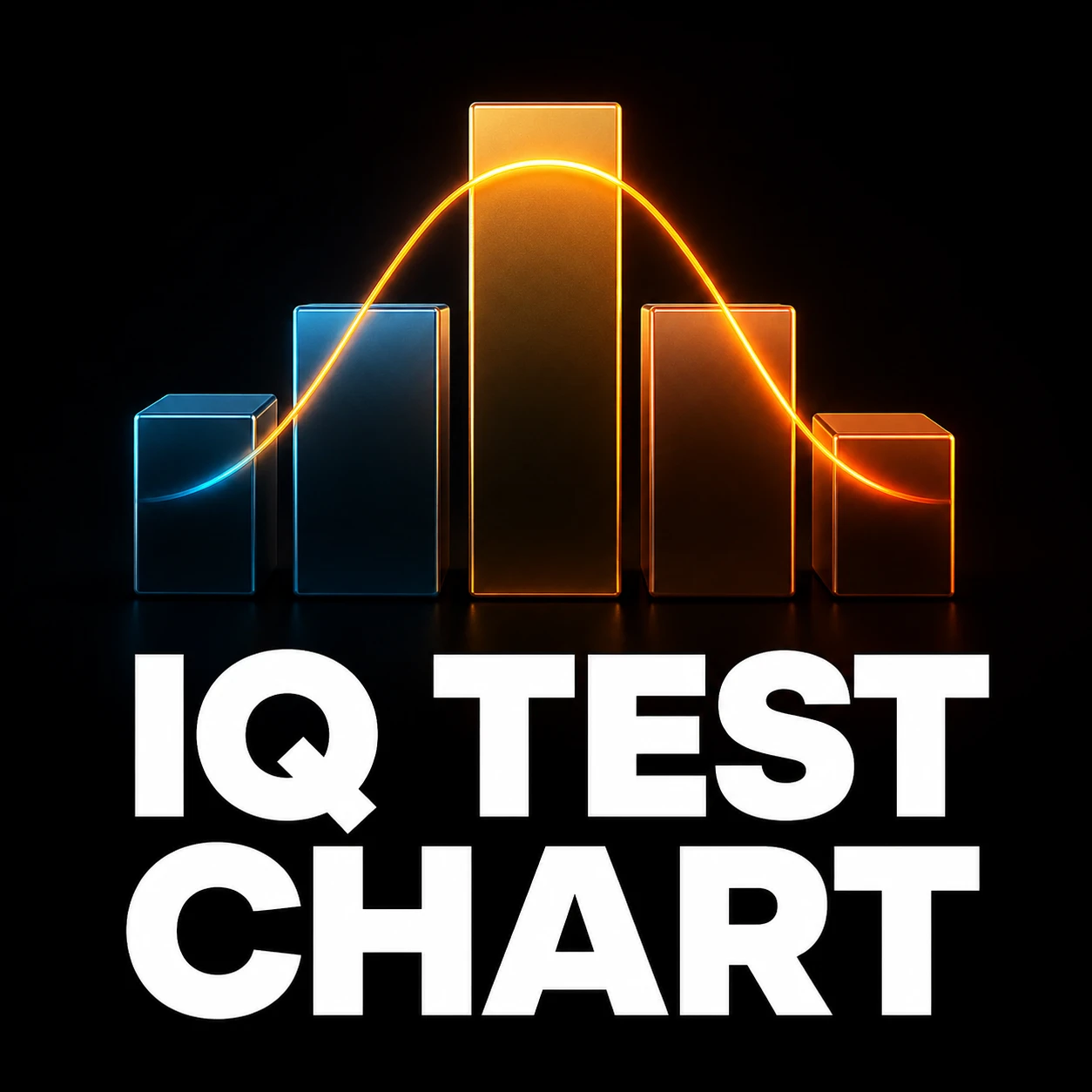
It is a position on a bell curve drawn from the wider population. The peak sits at 100, about two in three people fall between 85 and 115, and a score over 130 puts you in roughly the top two percent. That is the whole of its claim. It reports one performance on one set of tasks, not your worth, your character, or your future.
What are the IQ score ranges and classifications?
The WAIS-IV scheme runs in seven bands: Very Superior at 130 and up, Superior from 120 to 129, High Average from 110 to 119, then the Average band at 90 to 109 that holds about half of everyone, then Low Average (80 to 89), Borderline (70 to 79), and Extremely Low below 70. Handy shorthand, provided you keep in mind that each label is only a slice of the curve.
Can my IQ change over time?
Yes, though not all of it at the same time. The fluid side, your edge on unfamiliar problems, tends to crest in your twenties and drift down gently after. The crystallized side, vocabulary and accumulated know-how, can keep climbing for decades. Factor in schooling and a mentally active life, and any single score reads best as a snapshot rather than a fixed verdict.
Is the test really free?
Completely. Questions in, score and four domain results out, and nothing asked of you in between. There is no paywall, no card field, and no “unlock the full report” screen waiting at the end. A reasoning check this basic should not cost anything, so it does not.
Do I have to sign up or give an email?
Not at all. There is no account step, no email box, and no form standing in front of question one. Cutting that onboarding funnel was deliberate, so the only thing between you and your result is the test itself.
How is the test scored?
Each of the 33 items has one right answer. The page tallies your correct responses, leans a little more weight on the matrix items, then maps that raw total onto the standard IQ scale, mean 100 and standard deviation 15, using normative data. Alongside the overall figure you get a per-domain score, which is what reveals whether your verbal or spatial side is doing the heavy lifting.
Which cognitive domains does the test measure?
Four. The abstract block is the visual matrix patterns; the verbal block covers vocabulary and word relationships; the numerical block is sequences and quantitative logic; and the spatial block is mental rotation. Taken together they aim for a rounded read on general ability rather than a single narrow measure.
Can I retake the test?
Nothing stops you, but know what happens. Familiar puzzles are easier puzzles, so a repeat sitting usually nudges the score upward for reasons that have nothing to do with ability. Your first attempt is the cleanest reading. If you do come back, leave a gap of a few months so the specific items have faded.
How does this compare to the WAIS or Stanford-Binet?
Those are run face to face by a trained psychologist, last an hour or more, and remain the standard for formal diagnosis. This test shares their family of validated reasoning items and tracks them closely, which is what makes it a solid screen. What it cannot reproduce is the adaptive questioning or a clinician watching how you reach each answer.
Is IQ the same thing as intelligence?
No, and it helps to keep the two apart. An IQ test measures one cluster, the reasoning and pattern skills bundled under g. Intelligence in the everyday sense is wider than that: creativity, emotional read, street sense, knowing how to handle a room. All of it matters, and almost none of it shows up on a standard test.
What counts as a good IQ score?
Depends on the yardstick. 100 is the exact average, the 85-to-115 band holds most people, and anything past 120 is genuinely strong, around the top tenth. Even so, hunting for one magic threshold misses what the test is good for. The profile across your four domains tells you more than any single cutoff.
What is the average IQ score?
100, and not by accident. The scale gets re-normed from time to time so the population average stays pinned to 100 with a standard deviation of 15. Run the numbers and roughly half of people sit between 90 and 110, while about 95 percent fall somewhere between 70 and 130.
Does IQ predict career success?
It shifts the odds rather than settling the outcome. Research does tie higher scores to more schooling, stronger job performance, and better pay on average, but the grip is loose. Conscientiousness, drive, social skill, and luck often decide who actually gets there, and in many fields they count for more than raw reasoning. A score may open a door; walking through it is a separate skill.
Is intelligence nature or nurture?
Both, and the two resist being pulled apart. Twin studies put the heritable share of IQ variation somewhere from 50 to 80 percent, a figure that itself moves with age and circumstance. But genes lay out a range rather than a fixed point, and nutrition, schooling, and a stable home all shape where within that range a person finally lands.
What is the Flynn effect?
It is the label for a strange twentieth-century trend: raw IQ scores rose about three points per decade for generations, which is part of why tests need re-norming. Better nutrition, longer schooling, and more practice with abstract thinking are the leading explanations. Stranger still, in several wealthy countries that climb has recently stalled or turned down, and the reasons are still debated.
Does IQ decline with age?
Partly, and unevenly. Fluid reasoning, raw speed on unfamiliar problems, softens from the mid-twenties onward. Crystallized intelligence, your accumulated words and judgment, often keeps growing into your sixties and beyond. So the same older mind can be slower on a timed puzzle and distinctly sharper on anything that rewards experience.
What is the history of IQ testing?
The modern story opens in 1905, when Alfred Binet and Théodore Simon designed a test to identify French schoolchildren who needed extra support. Lewis Terman turned it into the Stanford-Binet in 1916, and David Wechsler added his own scales in 1939. Much has improved since, though the history also holds a dark chapter in which testing was pressed into the service of eugenics.
Any tips for getting an accurate score?
Choose a quiet moment when you are rested and alert, and silence the notifications. Work steadily without rushing or stalling; when an item traps you, commit to a best guess and keep going. Skip the slump right after a heavy meal and the fog of late at night. Above all, meet it with curiosity rather than dread, since anxiety quietly drags scores down.
What is the ICAR framework?
The International Cognitive Ability Resource: a public-domain pool of cognitive items developed by a team led by William Revelle at Northwestern University. Because the items are open for research and education, validated across several studies, and closely correlated with commercial tests, they let a free tool like this one stand on properly vetted psychometrics instead of guesswork.
Can I take the test on my phone?
Yes, it is built to work on one. The layout reflows for small screens, the answer targets are sized for thumbs, and nothing runs off the side. The mild exception is a couple of the spatial rotations, where fine detail reads more easily on a tablet or laptop. On a phone they are still perfectly doable.
What happens to my data?
It stays with you. Scoring happens in your browser, so your answers are never sent to a server, and we never ask for a name or email to begin with. Nothing that identifies you is stored unless you deliberately share a result. The operating rule is plain: if a piece of data is not needed to run the test, we do not collect it. The privacy policy spells out the details.